
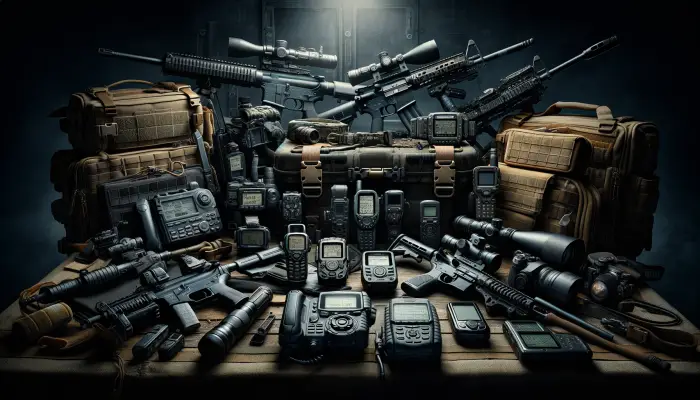
Overview: Tactical Gear for Hunters and Outdoor Enthusiasts
Whether you’re tracking elk through remote backcountry, coordinating with hunting partners across rugged terrain, or scouting game trails months before the season opens, the right tactical gear can make the difference between a successful hunt and a frustrating experience. This comprehensive buyer’s guide covers three essential categories of hunting technology: two-way radios for reliable communication, handheld GPS units for navigation, and trail cameras and rangefinders for scouting and precision shooting.
After researching dozens of products, analyzing user reviews from hunting forums like Rokslide and Long Range Hunting, and comparing specifications from manufacturers, we’ve identified the top performers in each category. Our recommendations prioritize durability, battery life, and real-world performance in challenging outdoor conditions.
“In general, handheld radios are line of sight, so if you are in a canyon it will be difficult to get someone in another canyon. If you are wanting to talk to someone several canyons over, you may want to look into a ham license.” — Rokslide Forum user
Advantages of Modern Hunting Tech
- Safety: Satellite communicators and two-way radios enable emergency contact in areas without cell service
- Coordination: GMRS radios allow hunting parties to communicate silently using vibrate modes and headsets
- Precision: Modern rangefinders with image stabilization and ballistic calculators deliver accurate shooting solutions
- Intelligence: Cellular trail cameras send real-time photos to your phone, allowing remote scouting
- Navigation: Multi-band GPS units maintain satellite lock even in deep canyons and under heavy tree canopy
Disadvantages
- Cost: Premium GPS units and quality radios represent significant investments ($180-$650 per device)
- Licensing: GMRS radios require a $35 FCC license; satellite communicators need subscription plans
- Learning curve: Advanced GPS features require time to master
- Battery dependency: Electronic gear requires charging or spare batteries in the field
Rocky Talkie Expedition Radio
The Rocky Talkie Expedition Radio has earned a devoted following among backcountry hunters, mountaineers, and skiers who demand reliable communication in extreme conditions. This 5-watt GMRS radio delivers the maximum power output legally allowed for handheld units, translating to 2-8 miles of typical range in mountainous terrain—with tested maximum ranges exceeding 35 miles under optimal conditions.
What sets the Expedition Radio apart is its purpose-built design for outdoor use. The specialized 1800 mAh battery delivers 4-6 days of use on a single charge, even in frigid conditions down to -20°F. Hand-tested to IP67 standards, the radio withstands full submersion in one meter of water. The rugged construction includes a shatterproof LED screen and tough thermoplastic housing that survives the abuse of backcountry hunting.
“I’ve owned these radios for 3+ years and they have never let me down. I’ve used them for mountaineering, backpacking, hunting, and exploring all over the Pac Nwest in all weather conditions. They are absolutely the best radios I have ever owned.” — Verified buyer review
The Expedition Radio offers 22 channels, 8 repeater channels, 121 privacy codes, NOAA weather channels, and dual channel monitoring. Antenna options—something competitors like Cobra, Midland, and Motorola don’t offer—allow you to optimize performance for your specific terrain.
Pros
- Exceptional 4-6 day battery life even in subzero temperatures
- IP67 waterproof rating for full submersion protection
- 5-watt maximum GMRS power output for extended range
- Outstanding audio clarity in testing—easy to understand every transmission
- Interchangeable antenna options for terrain-specific optimization
- NOAA weather channel access for backcountry weather updates
Cons
- Premium pricing at $180 per unit (budget $360+ for a pair)
- Requires $35 FCC GMRS license for legal operation
- Some forum users note cheaper Baofeng alternatives exist at $20 per unit
Best for: Serious backcountry hunters who need reliable communication in remote, challenging terrain and are willing to invest in premium quality. Skip if: You’re hunting local woods with cell service or need only basic family communication—more affordable options will suffice.
Midland GXT1050VP4 Two-Way Radio
The Midland GXT1050VP4 represents the sweet spot between premium performance and value pricing for hunters who need reliable GMRS communication without breaking the bank. This 5-watt radio delivers up to 36 miles of range under optimal conditions, though real-world performance typically yields 2-4 miles through obstructions—more than sufficient for most hunting scenarios.
What makes the GXT1050VP4 particularly appealing for hunters is its purpose-built feature set. The Mossy Oak camouflage housing blends with hunting gear, while the 5 animal call alerts (duck, crow, turkey, cougar, and wolf) provide legitimate utility for calling partners. Most importantly, the silent operation mode and included headsets allow whisper-quiet communication that won’t spook game.
“I have used hundreds of amateur and commercial radios and none have been as intuitive to set up and customize for personal preferences as the Midland Radio GTX1050VP4.” — Experienced amateur radio operator review
The JIS4 waterproof rating exceeds typical “weather resistant” consumer radios. Independent testing showed the radio functioning perfectly after having a quart of water poured directly onto its face and sides—no moisture entered the case. With 50 channels (22 GMRS plus 28 extra) and 142 privacy codes per channel, you’ll find clear frequencies even in crowded hunting areas.
Pros
- JIS4 waterproof rating verified through independent testing
- Silent operation mode and vibrate alerts for stealthy hunting
- Complete value pack includes headsets, rechargeable batteries, and dual chargers
- NOAA Weather Scan + Alert for severe weather warnings
- Significantly better range and audio quality than FRS-only radios in testing
Cons
- Claimed 36-mile range unrealistic—expect 2-4 miles in typical terrain
- 11-hour battery life with included rechargeable packs requires planning for multi-day hunts
- Requires $35 FCC GMRS license
Best for: Hunters wanting quality GMRS communication at a mid-range price point with hunting-specific features included. Skip if: You need multi-day battery life without access to charging or demand truly premium build quality.
Garmin GPSMAP 67i
The Garmin GPSMAP 67i stands as the flagship handheld GPS for serious hunters who demand reliable navigation and satellite communication in remote backcountry. Unlike GPS units requiring smartphone pairing, the 67i operates as a completely self-contained system—critical when you’re miles from cell service and need emergency SOS capability.
The multi-band GNSS technology (GPS, GLONASS, Galileo, QZSS, and IRNSS) delivers positioning accuracy within 6 feet, even under dense forest canopy or in tight slot canyons where lesser units lose satellite lock. Battery life is exceptional: 189 hours in GPS mode, extending to 840 hours in Expedition mode. The 16GB internal memory comes preloaded with TopoActive maps for the US and Canada.
“Garmin’s GPSMAP 67i is simply the best all around handheld GPS satellite communication device available. Unlike other GPS units that need to be paired with a smartphone, the 67i is capable of doing everything in one self-contained package.” — HikingGuy.com
For hunters specifically, the 67i offers compatibility with Applied Ballistics for calculating long-range shooting solutions, and the Outdoor+ Maps subscription provides hunting unit boundaries, satellite imagery, and state plat maps. The inReach satellite technology enables two-way text messaging, location sharing, and SOS emergency alerts anywhere on Earth—peace of mind when hunting alone in remote wilderness.
Pros
- Built-in inReach satellite communicator for emergency SOS and messaging
- Multi-band GNSS maintains lock in deep canyons and heavy timber
- Exceptional 189-840 hour battery life depending on mode
- Positive buttons work easily with gloves—unlike touchscreen phones
- MIL-STD-810 military durability standard with IPX7 water resistance
Cons
- Premium pricing at $599-$649 plus inReach subscription costs
- Software interface feels outdated and requires learning investment
- Less rugged than anticipated—scratches and scuffs more easily than older models
- Rechargeable internal battery can’t be swapped in the field like AA batteries
Best for: Backcountry hunters in remote areas who need satellite communication capability and reliable navigation regardless of terrain or weather. Skip if: You hunt areas with cell coverage, prefer simplicity over features, or can’t justify the premium investment.
Garmin eTrex 32x
The Garmin eTrex 32x delivers the core functionality hunters need—reliable GPS navigation with preloaded topo maps—at roughly half the price of premium units. For hunters who don’t need satellite communication but want a dedicated GPS that outperforms smartphone apps, the eTrex 32x represents the best value in its category.
The high-sensitivity GPS/GLONASS receiver with HotFix satellite prediction acquires position quickly and maintains lock in heavy cover and deep canyons. The 3-axis compass and barometric altimeter keep you oriented even when stopped, while 25 hours of battery life from standard AA batteries means you can always find power in the field. The 8GB internal memory, expandable via microSD, accommodates additional maps for any hunting destination.
“I found this unit performs well beyond its weight class compared to the more advanced models. An incredible value that does not skimp in reception and processing speed.” — Outdoor Gear Lab reviewer
At 142 grams, the eTrex 32x is lightweight enough for all-day carry, and compatibility with Garmin Huntview Maps provides hunting-specific data including property boundaries and game management units. The rugged construction handles the abuse of hunting without the delicate touchscreen vulnerabilities of smartphones.
Pros
- Best budget handheld GPS with button controls
- 25-hour battery life using standard AA batteries—field-replaceable power
- Sunlight-readable 2.2″ color display
- Compatible with Garmin Huntview Maps for hunting-specific features
- Rugged, reliable construction that simply works
Cons
- Small screen limits navigation complexity
- ANT+ only—no Bluetooth or WiFi connectivity
- Joystick interface feels dated compared to touchscreens
- No satellite communication capability for emergencies
Best for: Value-conscious hunters who want reliable dedicated GPS navigation without smartphone dependency. Skip if: You hunt truly remote backcountry where satellite emergency communication is essential.
Browning Dark Ops Pro X 1080 Trail Camera
Browning’s Dark Ops Pro X 1080 represents the pinnacle of conventional (non-cellular) trail camera technology, delivering the image quality, trigger speed, and battery life that serious hunters demand for pre-season scouting. The 24MP sensor captures detailed still images while 1080p video with sound documents animal behavior patterns.
The 0.19-second trigger speed ensures you capture animals as they enter the frame—not as they’re leaving. The 100-foot detection range and 90-foot flash range cover wide areas, while Browning’s invisible No Glo infrared illumination photographs game without the spooking effect of visible flash. Support for SD cards up to 512GB means months of images without swapping cards.
“In my opinion browning makes the best non cell cam out there for the money… taking pic quality, battery life, price and customer service into consideration.” — Rokslide Forum user
Battery performance is exceptional: on Energizer Ultimate Lithium batteries, the camera delivers 27 months of operation when taking 70 photos daily. The 1.5″ color view screen enables field configuration without connecting to a computer, and the all-steel adjustable mounting bracket simplifies setup.
Pros
- Industry-leading battery life—27 months on quality lithiums
- 0.19-second trigger speed captures fast-moving game
- Invisible No Glo IR doesn’t spook game or attract thieves
- 1.5″ color view screen for easy field setup
- 512GB SD card support for extended deployment
Cons
- No cellular capability—requires physical card retrieval
- Temperature readings can be inaccurate
- Higher price point than budget alternatives
Best for: Hunters who want maximum image quality and battery life from a conventional trail camera and can check cards in person. Skip if: You need real-time photo delivery to your phone or monitor remote properties you can’t visit regularly.
Sig Sauer KILO4K Rangefinder
The Sig Sauer KILO4K represents the current state-of-the-art in hunting rangefinders, combining Optical Image Stabilization with Applied Ballistics processing for shooting solutions that were previously available only in much larger and more expensive systems. The stabilization technology delivers crisp, shake-free images that transform ranging accuracy for one-handed use.
Maximum ranging extends to 4,000 yards on reflective targets, 2,000 yards on trees, and 1,600 yards on deer-sized game. The HyperScan mode delivers 4 range updates per second while scanning, and onboard environmental sensors automatically account for temperature, pressure, and humidity in ballistic calculations. Testing confirmed accuracy within 1-2 yards of other trusted rangefinders.
“Using the Sig Sauer KILO4K Rangefinder for the first time feels almost like you have never used a rangefinder ever before. You struggle to comprehend what you’re seeing, and how much the absolute ease of use with the stabilized image has for handheld use.” — LoadDevelopment.com
The Applied Ballistics UltraLite software includes a complete bullet database with support for 25 bullet profiles and 8 ballistic groups. BDX 2.0 connectivity allows the rangefinder to communicate with compatible Sig Sauer optics for instant holdover solutions. At 6x22mm, the unit is compact enough for all-day carry.
Pros
- Optical Image Stabilization eliminates hand shake for accurate ranging
- Applied Ballistics calculator with environmental sensors
- 4,000-yard maximum range on reflective targets
- HyperScan mode with 4 updates per second
- IPX-7 waterproof with 4,000 ranges per battery
- Integrated tripod mount for extreme long-range work
Cons
- Premium $599.99 price point
- Features may be overkill for typical hunting distances
- BDX ecosystem requires investment in compatible optics for full benefit
Best for: Long-range hunters and precision shooters who need accurate range data and ballistic solutions at extended distances. Skip if: You hunt primarily within 300 yards where simpler rangefinders suffice.
Comparison Table
| Product | Category | Price | Key Spec | Battery Life | Best For |
|---|---|---|---|---|---|
| Rocky Talkie Expedition | Radio | $180/unit | 5W GMRS, IP67 | 4-6 days | Backcountry hunting |
| Midland GXT1050VP4 | Radio | ~$80/pair | 5W GMRS, JIS4 | 11 hours | Value-focused hunters |
| Garmin GPSMAP 67i | GPS | $599-$649 | Multi-band GNSS + inReach | 189-840 hours | Remote backcountry |
| Garmin eTrex 32x | GPS | $299.99 | GPS/GLONASS, 3-axis compass | 25 hours (AA) | Budget GPS navigation |
| Browning Dark Ops Pro X | Trail Camera | $139.99 | 24MP, 0.19s trigger | 27 months | Conventional scouting |
| Sig Sauer KILO4K | Rangefinder | $599.99 | OIS, 4,000 yard max | 4,000 ranges | Long-range precision |
Buyer’s Guide: How to Choose Tactical Hunting Gear
Two-Way Radios
FRS vs. GMRS: FRS (Family Radio Service) radios are license-free but limited to 2 watts. GMRS (General Mobile Radio Service) radios offer up to 5 watts and access to repeater channels for extended range, but require a $35 FCC license valid for 10 years that covers your immediate family.
Range claims: Manufacturer range claims (20-36 miles) assume perfect line-of-sight conditions from mountain peaks. In real hunting terrain with trees, hills, and canyons, expect 1-4 miles typical range. For canyon-to-canyon communication, consider amateur (ham) radio licensing.
Hunting features to prioritize: Silent operation mode, vibrate alerts, and headset compatibility keep you from spooking game. Waterproof ratings (JIS4 or IP67) protect against weather. Multi-day battery life eliminates the need for frequent charging on extended hunts.
Handheld GPS Units
Smartphone apps vs. dedicated GPS: While apps like onX and Gaia offer excellent mapping, dedicated GPS units provide button operation with gloves, superior battery life, durability in adverse conditions, and independence from cell coverage. For remote backcountry, a dedicated unit is worth the investment.
Satellite communication: Units with inReach or similar technology enable emergency SOS, two-way messaging, and location sharing anywhere on Earth. This capability adds significant cost ($300-400 premium plus subscription fees) but provides potentially life-saving emergency contact in remote areas.
Battery considerations: Units using rechargeable internal batteries offer longer life but require battery banks for extended trips. Units accepting AA batteries can be powered indefinitely with spare batteries but offer shorter runtime per set.
Trail Cameras
Cellular vs. conventional: Cellular cameras ($100-200+ plus data plans) send photos directly to your phone—ideal for monitoring distant properties. Conventional cameras ($70-180) offer better battery life and lower ongoing costs but require physical card retrieval.
Key specifications: Trigger speed (0.15-0.5 seconds) determines whether you capture animals centered in frame. Detection range (60-100 feet) affects how much area each camera covers. Invisible (No Glo) infrared avoids spooking game and advertising camera locations to thieves.
Rangefinders
Basic vs. ballistic: Simple rangefinders provide distance only ($100-250). Ballistic rangefinders ($400-600+) calculate holdover and wind solutions using your specific rifle and ammunition data—essential for consistent accuracy beyond 400 yards.
Image stabilization: Optical Image Stabilization (OIS) eliminates hand shake, dramatically improving ranging accuracy at distance for one-handed use. This feature commands a price premium but transforms the ranging experience for long-range hunters.
Where to Buy
- Rocky Talkie Expedition Radio on Amazon
- Midland GXT1050VP4 on Amazon
- Garmin GPSMAP 67i on Amazon
- Garmin eTrex 32x on Amazon
- Browning Dark Ops Pro X 1080 on Amazon
- Sig Sauer KILO4K Rangefinder on Amazon
Frequently Asked Questions
Do I need a license for GMRS radios?
Yes. The FCC requires a GMRS license ($35, valid 10 years) to legally operate GMRS radios. The license covers you and your immediate family. FRS radios (limited to 2 watts) require no license but offer reduced range.
Can I use my smartphone instead of a handheld GPS?
Smartphones with offline maps work well in many hunting situations. However, dedicated GPS units offer advantages: button operation with gloves, superior battery life (25-800+ hours vs. ~10 hours), military-grade durability, and satellite communication capability for emergencies. For remote backcountry hunting, a dedicated GPS provides important redundancy.
How accurate are manufacturer range claims for radios?
Manufacturer claims (20-50 miles) represent theoretical maximum under perfect line-of-sight conditions. In typical hunting terrain with trees, hills, and canyons, expect 1-4 miles of reliable communication. Dense timber and canyon walls significantly reduce range.
Are cellular trail cameras worth the subscription cost?
Cellular cameras provide real-time scouting from home—invaluable for monitoring distant properties or tracking animal patterns during the season. If you can check cameras in person every few weeks, conventional cameras offer better value. Consider cellular for remote locations and conventional for accessible areas.
What’s the practical difference between 6x and 8x magnification on rangefinders?
Higher magnification (8x) makes distant targets larger but amplifies hand shake. With optical image stabilization, 6x magnification provides the best balance of target identification and stable ranging for handheld use. Without stabilization, some shooters prefer lower magnification.
Do I need satellite communication for hunting?
If you hunt remote backcountry beyond cell coverage, satellite communication capability (inReach, Zoleo, or similar) provides potentially life-saving emergency contact. For hunting areas with reliable cell coverage, it’s an unnecessary expense. Consider your typical hunting locations and risk tolerance.
Sources:
- Pew Pew Tactical – Best 2-Way Radios
- Outdoor Gear Lab – Best Handheld GPS
- Field & Stream – Best Trail Cameras
- Outdoor Life – Best Rangefinders for Hunting
- Rocky Talkie Official
- Garmin GPSMAP 67i Official
- Sig Sauer KILO4K Official
- Rokslide Forum
- Long Range Hunting Forum
Related Tactical Gear Guides
Explore our detailed guides on specific tactical gear products and applications:
- Best Radio for Hunters
- Top 10+ Best Tactical Chest Rigs
- Top 12+ Best Combat Trousers
- Top 12+ Best Shooting Gloves for Tactical, Women, Hunting & Pistol Shooting
- Top 5 Best QD Sling Mounts
- Top 5 Best Tactical Shotgun Scopes
- Top 7 Best GPS Watches for Hunting and Survival
- Top 7+ Best Tactical Self Defense Canes
GPS Watches & Communication Guides
- Best Garmin Watch for Hunting
- Garmin Tactix 7 Pro Ballistics Review
- Garmin Instinct 3 Solar Review
- Garmin Fenix 8 Review
- Garmin Enduro 3 Review
- COROS vs Garmin for Hunting
- GPS Watches with Topographic Maps
- Solar Powered GPS Watches
- Best GMRS Radios for Hunting
- Best Two-Way Radios for Wooded Areas
- Hunting Radios with Headset
- Garmin inReach Mini 2 Review
- Best Satellite Messengers for Hunting
- Personal Locator Beacons (PLBs)