
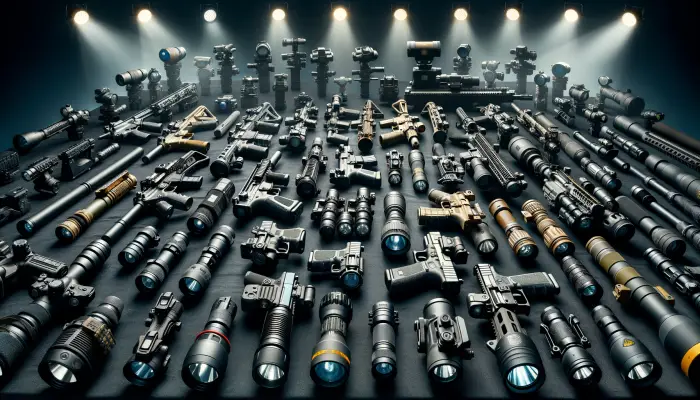
Weapon-mounted lights provide critical target identification capability in low-light situations. Whether you’re setting up a home defense pistol, building a patrol rifle, or adding capability to a hunting gun, understanding light specifications and mounting options helps you choose the right illumination tool.
This guide covers weapon lights, lasers, and the considerations for different platforms and applications.
Table of Contents
- Why Weapon Lights Matter
- Understanding Light Specs
- Lights by Platform
- Laser Aiming Devices
- Detailed Light Guides
Why Weapon Lights Matter
Target Identification
The fundamental rule of firearm safety requires positive target identification before shooting. In low light, this is impossible without illumination. A weapon light ensures you can identify threats before making critical decisions.
Hands-Free Operation
Weapon-mounted lights keep both hands on the gun, maintaining proper grip and control. Handheld flashlight techniques compromise shooting fundamentals and are difficult to maintain under stress.
Psychological Effect
High-lumen lights temporarily overwhelm dark-adapted vision. The sudden brightness creates hesitation and confusion in potential threats, providing tactical advantage in defensive situations.
Understanding Light Specs
Lumens
Total light output measured in lumens. Modern tactical lights range from 100 to 1000+ lumens. More isn’t always better – extremely high output in enclosed spaces causes blinding reflection.
Recommended ranges:
- Home defense: 300-600 lumens
- Outdoor/duty use: 500-1000 lumens
- Compact carry lights: 200-500 lumens
Candela
Intensity of the focused beam center, measuring throw distance. High candela with moderate lumens creates a tight beam reaching far. Lower candela with same lumens creates broader flood pattern.
Runtime
How long the light operates on a battery charge. Higher output means shorter runtime. Most quality lights provide 1-2 hours at maximum output, longer at reduced settings.
Lights by Platform
Handgun Lights
Mount to accessory rails on pistol frames. Size and weight matter more than on long guns. Compact lights suit concealed carry; full-size lights maximize output for duty and home defense.
Key considerations:
- Holster compatibility – not all holsters fit all lights
- Activation method – switch placement for your grip style
- Battery type – common batteries ensure availability
Rifle and Shotgun Lights
Larger bodies accommodate bigger batteries for more runtime and output. Pressure switch options enable remote activation. Mount positions vary based on handguard design and shooting style.
Subcompact Lights
Designed for micro-compact carry pistols with limited rail space. Lower output but proportional to their defensive role – most engagements occur within room distances.
Laser Aiming Devices
Visible Lasers
Red lasers: Most visible in low light, less visible in bright conditions. More affordable than green options.
Green lasers: Visible in daylight, easier for human eyes to track. Higher power consumption and cost.
Infrared Lasers
Invisible to the naked eye, visible through night vision devices. Used by military and law enforcement with NVG capability. Civilian models available with power restrictions.
Combo Units
Light and laser combinations provide both capabilities in a single unit. Simplifies mounting but increases single-point failure risk. Popular for home defense and duty applications.
Detailed Light Guides
Explore our weapon light reviews:
Streamlight
- Streamlight TLR-1 HL Review
- Streamlight 69260 TLR-1 HL Full Review
- Streamlight TLR-7 Compact Review
- Streamlight TLR-8 Light/Laser Combo
- Streamlight TLR-6 Subcompact Review
Other Brands
Airsoft and Training
Battery and Maintenance
Use quality batteries from reputable brands. Replace batteries on a schedule rather than waiting for failure. Check mounting screws periodically and verify zero if using aiming lasers. Clean lens surfaces with proper optical cloths – scratched lenses reduce output and create artifacts.
Store lights with batteries removed for long-term storage. Most modern lights are waterproof but verify seals remain intact after impacts or drops.
Training Considerations
Practice activating your light under stress. Know whether your switch is momentary or constant-on. Train transitions between light-on and light-off shooting. In home defense scenarios, consider when illumination helps versus when it reveals your position.
Recommended Products
Ready to buy? Here are our top picks: