
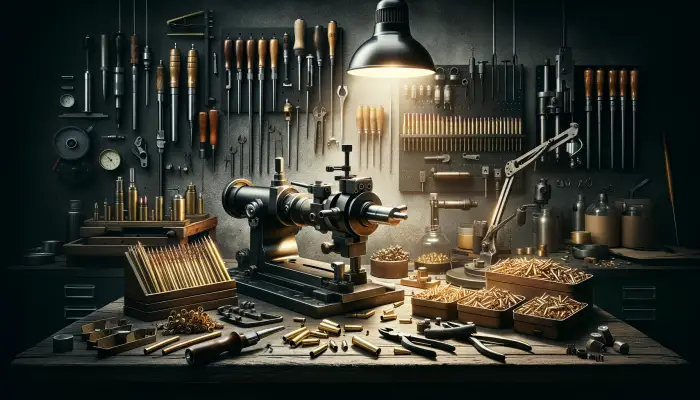
Reloading your own ammunition offers cost savings, improved accuracy, and the satisfaction of shooting rounds you created. Getting started requires understanding the equipment needed, the process involved, and the safety considerations that keep reloading enjoyable rather than dangerous.
This comprehensive guide covers every piece of equipment a beginning reloader needs, from presses and dies to measuring tools and organization systems.
Table of Contents
- Why Reload Your Own Ammunition?
- Reloading Presses
- Dies and Die Sets
- Measuring and Weighing Equipment
- Case Preparation Tools
- Priming Systems
- Powder Handling
- Organization and Storage
- Safety Equipment and Practices
Why Reload Your Own Ammunition?
Cost Savings
Reloading saves money on a per-round basis, especially for expensive calibers like .308, .300 Win Mag, or precision rifle cartridges. Initial equipment investment typically pays for itself within 500-2000 rounds depending on caliber. Savings compound significantly for high-volume shooters.
Accuracy Improvement
Hand-loaded ammunition tailored to your specific rifle often outperforms factory ammunition. You can develop loads optimized for your rifle’s barrel, chamber, and intended use. Precision shooters and competitors frequently reload to achieve consistent accuracy unavailable from factory sources.
Availability and Customization
Reloading provides ammunition independence from supply chain disruptions. You control component selection—bullet weight, powder charge, primer type—to create exactly what you need. Obsolete or hard-to-find calibers become accessible through reloading.
Reloading Presses
Single-Stage Presses
Single-stage presses perform one operation per pull. They’re ideal for beginners learning the process and for precision rifle reloading where consistency matters more than speed. RCBS Rock Chucker, Lee Classic Cast, and Hornady Lock-N-Load Classic represent quality single-stage options.
Turret Presses
Turret presses hold multiple dies simultaneously, rotating through operations without die changes. They offer a middle ground between single-stage precision and progressive speed. Redding T-7 and Lee Classic Turret are popular turret press choices.
Progressive Presses
Progressive presses perform all operations with each lever pull, producing a completed round per cycle. They’re optimized for volume—ideal for pistol cartridges and high-volume rifle loading. Dillon 550, Hornady Lock-N-Load AP, and Lee Loadmaster serve progressive loading needs. Higher learning curve but dramatically increased output.
Press Selection
Start with a single-stage press to learn fundamentals safely. Progress to turret or progressive presses once comfortable with the process. Most serious reloaders maintain a single-stage press for precision work alongside a progressive for volume loading.
Dies and Die Sets
Die Types
Standard die sets include a sizing die (resizes brass) and a seating die (seats bullets). Three-die sets for straight-wall pistol cartridges add a separate expander die. Full-length sizing dies resize the entire case; neck-sizing dies resize only the neck for improved accuracy in bolt-action rifles.
Quality Considerations
Quality dies produce consistent ammunition. RCBS, Redding, Hornady, and Lee manufacture reliable dies. Competition dies from Redding and Forster offer enhanced precision for accuracy-focused reloaders. Budget dies work adequately for plinking ammunition; precision work warrants premium dies.
Die Setup
Proper die adjustment is critical. Follow manufacturer instructions precisely. Invest in quality die lock rings that maintain settings. Check adjustment periodically—dies can shift during use. Keep dies clean and lightly oiled for smooth operation.
Measuring and Weighing Equipment
Powder Scales
Accurate powder measurement is critical for safe, consistent reloading. Balance beam scales (RCBS 5-0-5, Redding Model No. 2) offer reliability without batteries. Digital scales provide faster readings but require quality construction—cheap digital scales drift and fail. Consider both types: digital for speed, beam scale for verification.
Calipers
Digital calipers measure case length, overall cartridge length, bullet diameter, and other critical dimensions. Mitutoyo and Starrett make professional-grade calipers. Budget digital calipers from iGaging and others work adequately for reloading measurements. Measure overall length to verify safe chamber fit.
Case Gauges
Case gauges verify completed rounds fit within specification. Lyman, Wilson, and L.E. Wilson produce quality gauges. Check every round before shooting—especially in semi-automatic firearms where tight chambers won’t tolerate out-of-spec ammunition.
Case Preparation Tools
Case Trimmers
Brass grows with repeated firing and must be trimmed to specification. Manual trimmers (RCBS Trim Pro, Forster) handle occasional trimming. Power trimmers (Giraud, World’s Finest Trimmer) speed high-volume case preparation. Check case length after sizing—trim when cases exceed maximum specification.
Case Tumblers
Tumblers clean brass before reloading. Vibratory tumblers with corn cob or walnut media clean effectively at moderate cost. Ultrasonic cleaners and stainless steel pin tumblers provide deeper cleaning. Clean brass is easier to inspect and processes smoothly through dies.
Deburring Tools
Case mouth deburring removes sharp edges from trimmed brass. Flash hole uniforming creates consistent ignition. Chamfer tools ease bullet seating. These small tools improve ammunition quality incrementally—attention to detail separates adequate reloading from precision reloading.
Priming Systems
Hand Primers
Hand-held priming tools offer excellent feel for proper primer seating. RCBS Hand Primer, Lee Auto Prime, and Hornady Hand Primer are popular choices. Proper primer seating—flush to slightly below case head—is critical for reliable ignition. Hand priming develops feel that press-mounted priming lacks.
Press-Mounted Priming
Most presses include priming capability for convenience. Press-mounted priming works adequately but offers less tactile feedback than hand priming. Progressive press priming is necessarily press-mounted for workflow efficiency.
Primer Handling
Handle primers carefully—they’re explosive. Keep primers in original packaging until use. Don’t tumble live primers. Dispose of old primers properly. Work in ventilated areas. A primer detonation on a press is startling but rarely dangerous; a tray of loose primers is genuinely hazardous.
Powder Handling
Powder Measures
Powder measures dispense consistent charges quickly. Adjustable measures from RCBS, Hornady, and Redding serve most reloaders. Match the measure to your powder type—some measures throw fine ball powders more consistently than coarse extruded powders. Verify thrown charges on a scale until confident in measure consistency.
Powder Funnels
Simple funnels transfer weighed charges to cases. Powder tricklers add small amounts for precise charge weights. Anti-static funnels prevent powder sticking. These inexpensive tools make powder handling easier and safer.
Powder Storage
Store powder in original containers in cool, dry locations. Never mix powders. Mark containers clearly. Dispose of deteriorated powder safely—contact local authorities for proper disposal methods. Never store large quantities of powder in enclosed spaces.
Organization and Storage
Reloading Benches
A sturdy, dedicated reloading bench makes the hobby enjoyable. Commercial reloading benches are available, but many reloaders build their own. Requirements: solid mounting for the press, comfortable working height, good lighting, and adequate storage. Never rush reloading—a comfortable workspace prevents dangerous mistakes.
Component Storage
Organize bullets, brass, primers, and powder logically. Label everything clearly. Separate components by caliber to prevent dangerous mix-ups. Many reloaders use ammunition boxes to organize brass by firing count. Good organization prevents errors and makes reloading sessions efficient.
Record Keeping
Maintain detailed records of load development. Note powder charges, bullet weights, overall lengths, and accuracy results. Records help reproduce successful loads and avoid repeating failures. Loading manuals provide starting points; your records document what works in your specific firearms.
Safety Equipment and Practices
Safety Glasses
Always wear safety glasses when reloading. Primers can detonate unexpectedly. Brass can fail during sizing. Eye protection is non-negotiable—the small investment protects irreplaceable vision.
Loading Data
Always use published loading data from reputable sources. Never exceed maximum charges. Start 10% below maximum and work up watching for pressure signs. Multiple loading manuals provide cross-reference verification. The few dollars spent on loading manuals may prevent a destroyed firearm or serious injury.
Inspection
Inspect every component and completed round. Look for case defects, proper primer seating, consistent powder charges, and correct overall length. Segregate and destroy any suspect components or ammunition. The few rounds discarded cost far less than a damaged firearm or injury.
Reloading Equipment Guides
Explore our detailed equipment reviews:
- Best Single Stage Reloading Presses
- Best Calipers for Reloading
- Best Case Trimmer for Reloading
- Essential Reloading Tools Guide
- How to Choose Reloading Powder
- Best Powder Scales for Reloading
- Best Reloading Benches
- Best Brass Tumblers for Reloading
- The Ultimate Reloading Guide
Conclusion: Start Reloading Safely
Reloading offers tremendous benefits but demands attention to safety and detail. Invest in quality equipment, follow published data, and develop careful habits. Start with a single-stage press and simple caliber to learn fundamentals before advancing to progressive loading or precision techniques.
The initial equipment investment pays dividends in cost savings, ammunition availability, and shooting satisfaction. Take your time, do it right, and enjoy the journey into this rewarding aspect of the shooting sports.
Recommended Products
Ready to buy? Here are our top picks: