
Affiliate Disclosure: This article contains affiliate links to Amazon. We may earn a commission if you make a purchase through these links, at no additional cost to you. This helps support our independent gear testing and reviews.
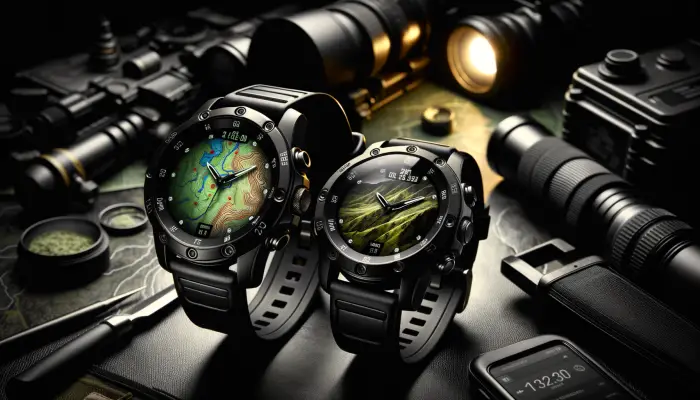
Topographic maps on your wrist eliminate the need for separate GPS units or phone apps that drain battery. For backcountry hunters navigating unfamiliar terrain, onboard topo maps provide critical situational awareness without additional devices.
Our top pick: the Garmin Fenix 8 delivers the best combination of preloaded TopoActive maps, multi-band GPS accuracy, and battery life—though the premium pricing isn’t for everyone.
“I’ll go weeks without a charge. Garmin uses TopoActive for mapping GPS… they’ve been 10-fold better than the iWatch.” — Archery Talk forum user discussing Garmin hunting watches
Overview: GPS Watches with Topographic Maps
| Watch | Map Type | GPS Battery | Screen Type | Price |
|---|---|---|---|---|
| Garmin Fenix 8 | TopoActive (preloaded) | 36-78 hrs | AMOLED or MIP | $999-$1,199 |
| Garmin Enduro 3 | TopoActive (preloaded) | 120-320 hrs | MIP with solar | $899 |
| Garmin Tactix 8 | TopoActive (preloaded) | 36-78 hrs | AMOLED | $1,299+ |
| COROS Vertix 2S | Downloadable | 118-140 hrs | MIP | $699 |
Advantages of Onboard Topo Maps
- No phone dependency: Navigate without draining smartphone battery or relying on cell service
- Terrain awareness: Identify saddles, benches, ridgelines, and water sources at a glance
- Multi-band GPS accuracy: According to DC Rainmaker’s testing, Garmin’s multi-band implementation maintains 6-8 foot accuracy even under dense forest canopy
- Weather resistance: Dedicated GPS watches handle rain, snow, and extreme temperatures better than smartphones
Disadvantages to Consider
- Premium pricing: $699-$1,299+ minimum investment for onboard maps
- Small screen: Even 51mm watches display limited map detail compared to phones or handheld GPS units
- No routing flexibility: Watch maps can’t replace detailed apps like onXhunt for property boundaries and satellite imagery
- Learning curve: Map navigation on a wrist requires practice compared to intuitive phone interfaces
Garmin Fenix 8 — Best Overall Maps ($999-$1,199)
The Fenix 8 represents Garmin’s flagship GPS watch with preloaded TopoActive maps for the US and Canada. Multi-band GPS maintains accurate positioning even under dense canopy or in deep canyons—DC Rainmaker’s testing confirmed “industry-leading” GPS accuracy across challenging mountain terrain and dense urban environments.
The AMOLED display option delivers 454×454 pixel resolution with 1000-nit brightness, making topo lines and trail details highly readable in direct sunlight. During DC Rainmaker’s 38km hike testing, the topo maps proved “absolutely crucial” for navigating overgrown sections that required bushwhacking—the topography showed where cliffs prevented passage and where cut-throughs were possible.
Available in 43mm, 47mm, and 51mm sizes, the Fenix 8 offers flexibility for different wrist sizes. The sapphire lens models include 32GB storage for additional map downloads covering any global region.
Map Features
- Preloaded content: Topographic maps, trail networks, points of interest
- Round-trip routing: Specify distance, get a loop back to your starting point
- Breadcrumb navigation: Record and retrace your exact route
- Huntview Plus compatible: Add public/private land boundaries ($29.99/year subscription)
- Multi-band GPS: Connects to GPS, GLONASS, Galileo, and BeiDou satellite systems simultaneously
Pros
- Industry-leading GPS accuracy verified by independent testing
- Brightest AMOLED option (1000 nits) for map readability in full sun
- Three size options (43mm/47mm/51mm) accommodate different wrist sizes
- Full Garmin ecosystem integration with inReach, dog collars, and other devices
- Regular firmware updates address bugs and add features
Cons
- High price: $300+ more expensive than previous Fenix 7 Pro models for MIP versions
- Battery trade-off: AMOLED display significantly reduces battery life compared to MIP option
- Launch bugs: Early firmware issues required dozens of fixes; now mostly resolved
- Button redesign: Shallower buttons feel less tactile with gloves than older Fenix models
- Auto-dimming issues: AMOLED auto-brightness can make display hard to read in low light
Who should buy: Hunters who want the best map display quality, value ecosystem integration with other Garmin devices, and prioritize screen readability over maximum battery life.
Who should skip: Hunters on multi-day trips without charging access, those on tight budgets, or anyone who found previous Fenix button feel ideal—the redesigned buttons feel different.
Garmin Enduro 3 — Best Battery Life with Maps ($899)
The Enduro 3 delivers the same TopoActive maps as the Fenix 8 with 120+ hours of GPS battery life—up to 320 hours with solar charging in optimal conditions. For multi-day backcountry hunts where charging isn’t possible, no other GPS watch with maps comes close.
Outdoor Gear Lab testing confirmed the Enduro 3 as “the king” of battery life for GPS watches. Even with all satellite systems running including multi-band GPS, the watch lasts 60-90 hours depending on sunlight exposure. The solar charging actually works—in a 2024 Backpacker Magazine survey, over 60% of long-distance hikers listed battery life as their top criterion.
“If battery life is king, the Enduro 3 is the king. It might be the best option on the market for thru-hikers who hate charging.” — The Trek
Despite its 51mm case, the titanium construction keeps weight to just 63g with the UltraFit nylon band. Multiple reviewers noted forgetting they were wearing it during extended backcountry trips.
Pros
- Unmatched 120-320 hour GPS battery life with solar
- Same TopoActive maps and multi-band GPS as Fenix 8
- $100+ less expensive than comparable Fenix 8 models
- Lightweight titanium construction (63g) despite large size
- Solar charging provides meaningful battery extension in field conditions
Cons
- Single size: Only available in 51mm—too large for smaller wrists
- No AMOLED option: MIP display less vibrant for map details than Fenix 8 AMOLED
- No speaker/microphone: Can’t use voice features or speakerphone functionality
- Lower resolution: MIP display (280×280) shows less map detail than AMOLED (454×454)
Who should buy: Hunters on extended backcountry trips (5+ days), those who prioritize battery life above all else, and users comfortable with larger watch sizes.
Who should skip: Anyone with smaller wrists, hunters who want the crispest map display, or those who value speaker functionality for voice commands.
Garmin Tactix 8 — Maps Plus Tactical Features ($1,299+)
The Tactix 8 adds stealth mode, night vision compatibility, and Applied Ballistics support to the Fenix 8 platform. Same TopoActive maps with additional tactical features designed for military and law enforcement users—though many hunters appreciate the kill switch and night vision green display mode.
GearJunkie’s review praised the Tactix 8 as “the ultimate hunter’s watch,” highlighting the stealth mode that disables wireless connections and prevents location sharing. The night vision compatibility maintains situational awareness when using NV optics without destroying dark-adapted vision.
Applied Ballistics integration provides on-wrist holdover data for long-range shooters—useful for western hunters taking 400+ yard shots on open terrain. However, reviewers note that the mapping on any Garmin watch “is nowhere near a replacement for dedicated apps like onXhunt” for detailed property boundaries.
Pros
- Night vision compatible green display mode
- Stealth mode disables all wireless connectivity and location data
- Applied Ballistics integration for long-range shooting
- Same excellent TopoActive maps as Fenix 8
- Kill switch instantly wipes sensitive data
Cons
- Extreme pricing: $1,299+ starting price—$300+ premium over Fenix 8
- Tactical overkill: Military-grade features go unused by most hunters
- Security concerns: Professionals note that the new microphone and multi-GNSS (including Russian GLONASS/Chinese BeiDou) raise concerns for actual tactical use
- Large size: 47mm and 51mm sizes only—no compact option
- Aviation features removed: Critical aviation features from Tactix 7 were removed, disappointing pilot users
Who should buy: Hunters who use night vision equipment, long-range shooters who want Applied Ballistics on their wrist, or those requiring data security features.
Who should skip: Budget-conscious hunters (Fenix 8 offers 95% of features for $300 less), anyone who doesn’t specifically need tactical features, and pilots expecting aviation functionality.
COROS Vertix 2S — Best Value Maps ($699)
COROS offers downloadable topographic maps at no additional cost—but they require uploading before trips. The 140-hour GPS battery life and $699 price point make it the most affordable option for hunters who want topo maps without Garmin’s premium pricing.
DC Rainmaker’s review noted that map navigation via touchscreen is “not only nifty, but also nearly instantaneous.” The 2024 firmware update added an extender feature that mirrors real-time map data to your phone, providing a larger display when detailed navigation is needed.
However, COROS maps function more as “backgrounds” than true navigation tools—you can’t re-route on these maps or route to arbitrary destinations. Routes must be pre-planned and uploaded, then followed breadcrumb-style with the topo map as a visual reference.
Key Considerations
- Maps must be downloaded via WiFi (2.4 GHz only) and uploaded before trips—plan ahead
- No Garmin ecosystem integration (no inReach, dog collar, or Huntview Plus compatibility)
- 118-hour GPS battery life is competitive but slightly less than predecessor Vertix 2
- Map storage: 32GB capacity handles regional topo maps without issues
Pros
- $200-$500 less expensive than Garmin alternatives with maps
- 118-hour GPS battery life competes with Enduro 3 for multi-day trips
- Free map downloads—no additional subscription for basic topo maps
- Touchscreen map navigation works smoothly
- Lightweight despite rugged construction
Cons
- Maps require pre-planning: Cannot download maps in the field—must upload before trips
- No Garmin ecosystem: Can’t integrate with inReach, Astro dog collars, or Huntview Plus
- Music limitations: Can only transfer MP3 files via USB—no Spotify or streaming integration
- MIP display only: No AMOLED option; screen “can be a bit dull” according to reviewers
- Sensitive scroll wheel: Outdoor Gear Lab noted accidental button presses during activities requiring wrist flexion
- Heart rate accuracy: Testing showed average discrepancies of +/- 12 BPM compared to chest straps
- Proprietary charging cable: COROS-specific cable required—can’t use standard USB-C
Who should buy: Budget-conscious hunters comfortable with trip pre-planning, those who don’t need Garmin ecosystem integration, and users who prioritize battery life and value.
Who should skip: Hunters who rely on Garmin devices (inReach, dog collars), those who want spontaneous trip navigation without pre-planning, and anyone expecting full routing functionality.
Watches WITHOUT Topographic Maps
These popular hunting watches provide GPS tracking but not onboard maps:
- Garmin Instinct 3 Solar: Breadcrumb navigation only—no topo map display
- COROS Apex 2 Pro: Downloadable maps available but smaller storage limits regional coverage
- COROS Pace 3: No map support—designed for road running, not backcountry navigation
Breadcrumb navigation records your path and guides you back—useful for retracing your route to camp but fundamentally different from seeing terrain features, trails, and topography on screen. If you primarily hunt familiar areas and use phone apps for detailed navigation, breadcrumb-only watches save $400-$800.
Do You Need Onboard Maps?
Maps Are Essential If:
- You hunt unfamiliar areas regularly and need terrain awareness without stopping
- You prefer not to carry or rely on phone for backcountry navigation
- You navigate to specific terrain features (saddles, benches, water sources) identified on topo maps
- Your hunts involve true backcountry with no cell service or road access
- Weather conditions (rain, snow, extreme cold) make phone use impractical
Breadcrumb Navigation Suffices If:
- You hunt familiar properties and know the terrain
- You use dedicated phone apps like onXhunt for detailed navigation
- You primarily need to retrace your path back to camp or truck
- Budget priorities favor other gear investments
- You carry a separate handheld GPS for detailed navigation
GPS Accuracy: What the Testing Shows
Multi-band GPS (also called dual-frequency) represents a significant accuracy improvement over standard GPS, particularly in challenging environments hunters frequently encounter.
DC Rainmaker’s extensive testing confirmed Garmin’s multi-band implementation delivers “industry-leading” accuracy across multiple sports and environments. Key findings:
- Dense canopy: Multi-band GPS maintained 6-8 foot accuracy where single-band struggled to stay within 30 feet
- Canyon terrain: Consistent positioning in steep valleys where satellite visibility is limited
- Urban environments: The Fenix 8 handled 20-30 story building corridors with minimal track drift
Additional testing from HikingGuy showed multi-band devices were “400% more accurate than basic GPS units in challenging environments” under heavy Pacific Northwest canopy.
Practical implication for hunters: When tracking wounded game through thick timber or navigating to a specific ridgeline saddle, multi-band GPS reduces position uncertainty from ~30 feet to ~6-8 feet—meaningful when every step matters.
Map Subscription: Huntview Plus
Garmin’s Huntview Plus subscription ($29.99/year) adds layers specifically designed for hunters:
- Public/private land boundaries: Critical for avoiding trespass violations
- Game management units: See unit boundaries directly on watch
- Satellite imagery overlay: More detail than topo maps alone
- Property owner information: Where available through county records
For hunters who rely on public land access, Huntview Plus provides boundary information directly on the watch—though many users note that dedicated hunting apps on smartphones offer more detailed and frequently updated property data.
Screen Readability: AMOLED vs. MIP
Display type significantly affects map usability in the field:
AMOLED (Fenix 8, Tactix 8)
- Pros: 1000-nit brightness excellent in direct sun, 454×454 resolution shows fine topo detail, vibrant colors distinguish terrain features
- Cons: Significantly higher battery consumption, auto-dimming can reduce readability in low light, no solar charging option
MIP with Solar (Enduro 3, Fenix 8 Solar)
- Pros: Readable in any lighting condition including harsh glare, solar charging extends battery, lower power consumption
- Cons: 280×280 resolution shows less map detail, less vibrant colors, no backlight illumination in darkness
Recommendation: For hunters who frequently check maps in bright daylight, either display works well. For extended backcountry trips where battery matters, MIP with solar provides practical advantages despite lower resolution.
Buyer’s Guide: Choosing the Right GPS Watch
Trip Length
- Day hunts: Any model with maps works; AMOLED displays show more detail
- 2-3 day trips: Fenix 8 AMOLED sufficient with overnight charging or power bank
- 4-7 day trips: Enduro 3 or Fenix 8 Solar provides reliable battery without charging
- Extended expeditions (7+ days): Enduro 3 with solar is the only realistic choice
Budget Considerations
- Under $700: COROS Vertix 2S offers maps at lowest price point
- $900-$1,000: Enduro 3 delivers Garmin ecosystem with best battery
- $1,000-$1,200: Fenix 8 provides best display options and features
- $1,300+: Tactix 8 only if specific tactical features required
Ecosystem Integration
Garmin watches integrate with:
- Garmin inReach satellite communicators
- Garmin Alpha/Astro dog tracking collars
- Huntview Plus subscription service
- Garmin Connect ecosystem for trip planning
COROS lacks this ecosystem—a dealbreaker for hunters already invested in Garmin devices.
Frequently Asked Questions
Are watch topo maps as good as phone apps?
No. Watch maps provide terrain awareness and basic navigation, but phone apps like onXhunt offer more detailed property boundaries, better satellite imagery, and larger screens. Watch maps work best as supplements to phone apps, not replacements.
How accurate is GPS under tree canopy?
Multi-band GPS (available on all watches listed) maintains 6-8 foot accuracy under dense canopy. Single-band GPS can drift to 30+ feet in the same conditions. For tracking wounded game or navigating to specific terrain features, this difference matters.
Do I need Huntview Plus if I have onXhunt?
Most hunters don’t need both. Huntview Plus puts basic boundary data on your watch; onXhunt provides more detailed and frequently updated information on your phone. If you already use onXhunt, Huntview Plus adds convenience but limited new information.
Can I download maps in the field?
Garmin watches with WiFi can download maps wherever you have connection. COROS watches require pre-planning—maps must be uploaded before trips via WiFi or USB.
How long do batteries actually last with maps and GPS running?
Manufacturer claims assume specific conditions. Real-world expectations with GPS and regular map checking: Fenix 8 AMOLED (20-30 hours), Fenix 8 MIP Solar (50-70 hours), Enduro 3 (80-150 hours depending on solar), COROS Vertix 2S (70-100 hours).
Is the AMOLED display worth the battery trade-off?
For day hunts and trips with charging access, yes—the display quality difference is significant. For multi-day backcountry trips, MIP displays with solar charging provide necessary battery life.
Verdict
Onboard topographic maps require premium pricing—$699 minimum, typically $899-$1,199 for optimal capability. Each watch suits different priorities:
- Garmin Enduro 3 ($899): Best value for hunters needing maps with maximum battery life. The multi-day battery solves real problems on backcountry hunts.
- Garmin Fenix 8 ($999-$1,199): Best display quality and feature set, with size options for different wrists. Choose AMOLED for map clarity or Solar for extended trips.
- Garmin Tactix 8 ($1,299+): Only if you specifically need night vision compatibility, stealth mode, or Applied Ballistics. Otherwise, the Fenix 8 offers better value.
- COROS Vertix 2S ($699): Best budget option if you can pre-plan trips and don’t need Garmin ecosystem integration.
If onboard maps aren’t essential, save $400-$800 with the Instinct 3 Solar and use phone apps for detailed navigation when needed.