
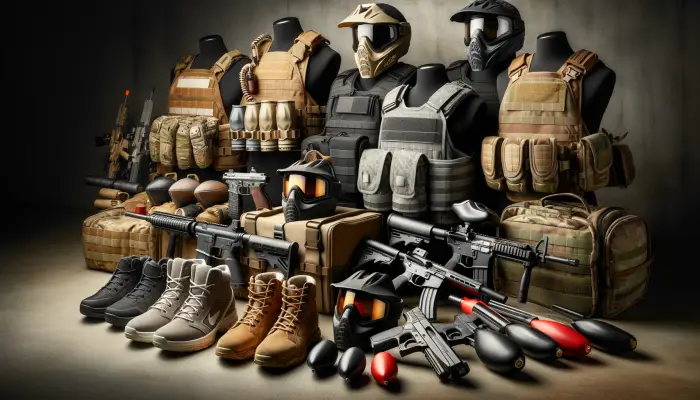
Airsoft and paintball offer realistic tactical training, competitive sports, and pure recreational fun. Whether you’re building a loadout for MilSim events, weekend skirmishes, or backyard target practice, understanding the equipment landscape helps you make smart purchasing decisions.
This guide covers airsoft guns, paintball markers, and the gear that supports both sports.
Table of Contents
- Airsoft Basics
- Paintball Fundamentals
- Choosing Your Platform
- Budget Considerations
- Detailed Gear Guides
Airsoft Basics
Types of Airsoft Guns
Airsoft guns fall into three main categories based on their power source:
AEGs (Automatic Electric Guns): Battery-powered guns offering semi and full-auto fire. AEGs dominate competitive airsoft due to their reliability, consistency, and magazine capacity. The M4 platform remains the most popular, with extensive aftermarket support.
Gas-Powered: Using green gas, CO2, or propane, these guns offer realistic blowback action and feel. Popular for pistols and collectors seeking authentic replicas. Temperature sensitivity affects performance in cold weather.
Spring-Powered: Manual cocking required for each shot. Excellent for beginners and sniper rifles where single-shot precision matters more than rate of fire.
FPS and Field Limits
Feet per second (FPS) ratings determine where you can use your gun. Most indoor fields limit AEGs to 350 FPS, outdoor fields to 400 FPS, with sniper rifles allowed up to 500 FPS with minimum engagement distances. Always check field rules before purchasing.
Paintball Fundamentals
Marker Types
Mechanical Markers: Simple, reliable, and low-maintenance. Perfect for beginners and woodsball players who value durability over rate of fire.
Electronic Markers: Battery-powered triggers enabling rapid fire modes. Essential for speedball competition but require more maintenance and battery management.
Pump Markers: Single-shot operation requiring manual pump between shots. Emphasizes accuracy and strategy over volume of fire.
Woodsball vs. Speedball
Woodsball uses natural terrain with scenario-based games. Equipment tends toward realistic military styling with emphasis on durability. Speedball uses inflatable bunkers on flat fields with fast-paced elimination games. Equipment prioritizes weight reduction and rate of fire.
Choosing Your Platform
Airsoft Advantages
- Lower ongoing costs (BBs are cheaper than paintballs)
- More realistic replicas and gear
- Greater range and accuracy potential
- Cleaner – no paint splatter
Paintball Advantages
- Clear hit confirmation (paint marks)
- Established commercial fields everywhere
- Rental equipment widely available
- More accessible for casual play
Budget Considerations
Entry-Level ($100-200)
Quality starter AEGs and mechanical paintball markers fall in this range. Expect functional performance suitable for learning the sport. Budget for eye protection, BBs or paint, and a charger or CO2.
Mid-Range ($200-400)
Significant upgrade in build quality, accuracy, and features. Metal receivers, better internals, and improved hop-up systems. This is where most dedicated players settle for their primary guns.
High-End ($400+)
Competition-grade equipment with premium internals, materials, and performance. Worth it for serious competitors or collectors seeking the best.
Detailed Gear Guides
Explore our comprehensive airsoft and paintball equipment reviews:
Airsoft Guns by Type
- Top 9 Best Quality Airsoft Guns
- Top 7 Best Airsoft Sniper Rifles
- Top 8 Best Airsoft M4 AEGs
- Top 8 Best Airsoft Guns For CQB
- Top 10+ Best Airsoft Revolvers
- Top 6 Best Airsoft Glock Replicas
Airsoft Guns by Budget
Paintball Markers
- Top 7 Most Realistic Paintball Guns
- Top 6 Best Woodsball Paintball Guns
- Top 6 Best Tippmann Paintball Guns
Accessories
Safety First
Both sports require proper eye protection rated for impact. ANSI Z87.1+ rated goggles or full-face masks are mandatory at all organized events. Never remove eye protection during gameplay, and always treat replicas as real firearms when in public to avoid dangerous misunderstandings with law enforcement.
Store equipment securely and transport in proper cases. Many jurisdictions have laws regarding airsoft gun appearance and transport – know your local regulations.